Ukulele Serenade
Tuning methods
Four tunings plus a tuning-check page: open-string names, how long new strings take to settle, and which tuning suits which player.
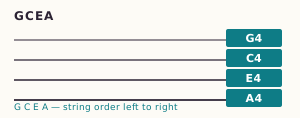
Reading from the string nearest your chin to the string nearest the floor: **G, C, E, A**. The pitches are G4, C4, E4 and A4 — and that is the whole trick of a ukulele. The G string is *higher* than the C string, not lower. This is called re-entrant tuning, and it is why a four-string instrument sounds bigger than its size suggests.
GCEA
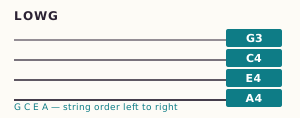
Low G tuning changes exactly one string: the fourth string drops a full octave from G4 to G3. Everything else stays put. Reading near your chin to near the floor you get **G3, C4, E4, A4** — four notes in ascending order, which is why it is called linear tuning.
LowG
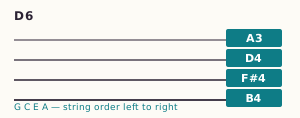
Take standard GCEA and raise every string by a whole step. You get **A3, D4, F sharp 4, B4** — still re-entrant (the fourth string is higher than the third), still four strings a fourth, a major third and a fourth apart. This is the "D tuning" that most ukulele sheet music published before 1930 assumes.
D6
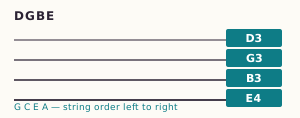
Baritone tuning is **D3, G3, B3, E4** — the top four strings of a guitar, in the same order, at the same pitches. It is linear, not re-entrant, and the instrument that carries it is usually 19 to 21 inches long instead of 13 to 15.
DGBE
Four short, light nylon strings at low tension: the physics is against you. Nylon stretches for days after it is fitted, the small body responds to every change in room temperature, and the short scale means a tiny slip in tension moves the pitch further than it would on a guitar.
GCEA