LowG
Low G (Linear) Tuning
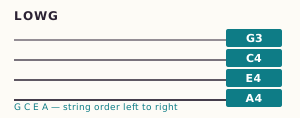
Low G tuning changes exactly one string: the fourth string drops a full octave from G4 to G3. Everything else stays put. Reading near your chin to near the floor you get **G3, C4, E4, A4** — four notes in ascending order, which is why it is called linear tuning.
Tuning: LowG · Open strings: G3 C4 E4 A4
One string, a different instrument
Low G tuning changes exactly one string: the fourth string drops a full octave from G4 to G3. Everything else stays put. Reading near your chin to near the floor you get G3, C4, E4, A4 — four notes in ascending order, which is why it is called linear tuning.
The consequence is larger than it sounds. Every chord that uses the open fourth string now has a bass note underneath it instead of a treble note inside it. C, Am, F and G7 all change character.
What it fixes and what it costs
Fixed: fingerpicking gets a real bass line; the instrument stops sounding thin on slow songs; chord melodies become possible because the melody can sit on top and the bass underneath.
Cost: the ukulele loses its characteristic sparkle. A high G cuts through a noisy room; a low G sits under it. Fast strumming in a group can turn muddy because the fourth string now competes with the C string for the same frequency space.
- Best for:
Aloha Oe,Amazing Grace,Shenandoah, any solo fingerpicked arrangement. - Worse for:
Oh! Susanna, campfire strumming with four or more players. - Octave check: the low G must be exactly one octave below the high G, not "as low as it goes". If the string feels floppy, the gauge is wrong.
Fitting the string
A wound low G string is thicker than a plain high G and will not fit some nut slots. Three options, in order of preference:
- Buy a low G set with a correctly gauged fourth string.
- Have the nut slot widened by 0.1-0.2 mm with a nut file — a two-minute job for a shop.
- Rest the string on top of the slot. It works, it buzzes occasionally, and it is a temporary fix only.
Reading the note strip
The tuning card prints G3 C4 E4 A4 in string order. Notice that the numbers now ascend from top to bottom — that is the visual signature of linear tuning, and it is the fastest way to tell which tuning an arrangement was written for.
Questions that come up
Do I need a different chord book for low G?
No. The shapes are identical. What changes is the voicing: a C chord in low G has a low G under it rather than a high G inside it. Read the same frames and expect a heavier sound.
Will low G damage my ukulele?
Not if the string tension is right. A low G string is thicker but tunes to a lower pitch, so the total tension is similar. The only real risk is a nut slot that is too narrow, which can pinch the string.