GCEA
Tuning Checks and Letting New Strings Settle
Four short, light nylon strings at low tension: the physics is against you. Nylon stretches for days after it is fitted, the small body responds to every change in room temperature, and the short scale means a tiny slip in tension moves the pitch further than it would on a guitar.
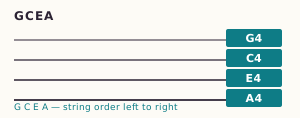
Tuning: GCEA · Open strings: G4 C4 E4 A4
Why a ukulele goes out of tune so fast
Four short, light nylon strings at low tension: the physics is against you. Nylon stretches for days after it is fitted, the small body responds to every change in room temperature, and the short scale means a tiny slip in tension moves the pitch further than it would on a guitar.
The habit that fixes most of it: tune up to pitch, never down. If a string is sharp, drop it below the note and come back up. Coming up to pitch leaves the string wound tight against the post; coming down leaves it loose and it will drift the moment you play a chord.
The five-point check before you play
- Open strings with a tuner, G C E A, tuning up to pitch each time.
- Fifth fret of the G string should equal the open C string. If it is sharp, the string is too high at the nut.
- Fourth fret of the C string should equal the open E string.
- Fourth fret of the E string should equal the open A string.
- Twelfth fret harmonic should equal the open string. If the twelfth fret is sharp, the saddle needs adjusting; if it is flat, the string is old.
Steps 2 to 4 catch a bad nut, a worn string or a slipped tuning peg in thirty seconds without any equipment.
Letting new strings settle
A fresh set needs two to four days of playing before it holds pitch for a whole song. Three things speed that up:
- Stretch gently. After tuning, pull each string about 2 cm away from the fretboard and let it snap back, then retune. Repeat three times. This is safe on nylon and does more than anything else.
- Play, then retune. Tune, play a song, retune. Four cycles in the first hour is normal.
- Check the knots. A slipping bridge knot is the most common cause of a string that goes flat every few minutes. Pull the knot tight against the bridge and re-tune.
When to change strings
Nylon strings go dead rather than break. The signs: the fourth string sounds dull, intonation at the twelfth fret goes sharp, and the string develops flat spots where the frets touch. For daily playing, a new set every two to three months; for occasional playing, twice a year.
Questions that come up
Should I tune with a chromatic tuner or a ukulele-specific one?
Either works. A chromatic tuner is more useful because Low G and baritone players need it, and because it lets you check the fifth-fret reference notes above. Avoid the clip-on tuners that only offer C G E A modes.
How hard should I press my finger behind the fret?
Just enough that the note rings cleanly, and no more. Pressing harder raises the pitch slightly and will make your tuning checks in steps 2 to 4 read sharp even when the string is fine.