D6
D6 Tuning (A D F sharp B)
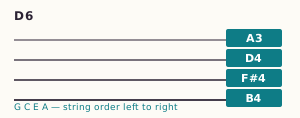
Take standard GCEA and raise every string by a whole step. You get **A3, D4, F sharp 4, B4** — still re-entrant (the fourth string is higher than the third), still four strings a fourth, a major third and a fourth apart. This is the "D tuning" that most ukulele sheet music published before 1930 assumes.
Tuning: D6 · Open strings: A3 D4 F#4 B4
What D6 is
Take standard GCEA and raise every string by a whole step. You get A3, D4, F sharp 4, B4 — still re-entrant (the fourth string is higher than the third), still four strings a fourth, a major third and a fourth apart. This is the "D tuning" that most ukulele sheet music published before 1930 assumes.
The name D6 is a chord reference: the four open strings together spell a D6 chord (D, F sharp, A, B).
What it changes
- Everything sounds a whole step higher. Same shapes, brighter tone, more cut in a noisy room.
- Strings are tighter. Higher pitch at the same scale length means more tension, which usually means better intonation and a snappier attack — and a little more finger pressure.
- Stretches get shorter. Fret spacing is unchanged, but the higher tuning makes close voicings in first position sound cleaner, which is why early jazz players liked it.
Retuning from GCEA
Tune the fourth string up to A, the third up to D, the second up to F sharp and the first up to B. Do it string by string with a tuner and stop if a string feels like it is fighting you — a whole step up on a light set is safe, a whole step up on a set already tuned to pitch for GCEA is at the limit. If in doubt, buy a D-tuning string set.
- Reference pitches: A3, D4, F sharp 4, B4.
- All four strings move the same distance, so the instrument stays balanced.
- A capo on fret 2 of a GCEA ukulele sounds identical to D6. If you only want the sound for one song, use the capo instead.
Who should use it
Players working from pre-war sheet music, players in a loud group where GCEA gets buried, and anyone who likes the tighter feel. Every chord frame on this site still applies — the shapes are identical, only the sounding pitch moves.
Questions that come up
Is D6 the same as "D tuning"?
Yes. Older books say "D tuning" and newer ones say D6; both mean A-D-F sharp-B. The name D6 comes from the chord the open strings spell.
Will D6 tuning hurt the ukulele?
Not if you use strings meant for it. Tuning a standard GCEA set up a whole step raises tension by roughly 12 percent, which is usually fine on a soprano but worth checking on an older instrument with a lightly braced top.