GCEA
Standard GCEA (Re-entrant) Tuning
Reading from the string nearest your chin to the string nearest the floor: **G, C, E, A**. The pitches are G4, C4, E4 and A4 — and that is the whole trick of a ukulele. The G string is *higher* than the C string, not lower. This is called re-entrant tuning, and it is why a four-string instrument sounds bigger than its size suggests.
Tuning: GCEA · Open strings: G4 C4 E4 A4
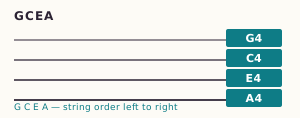
What GCEA actually means
Reading from the string nearest your chin to the string nearest the floor: G, C, E, A. The pitches are G4, C4, E4 and A4 — and that is the whole trick of a ukulele. The G string is higher than the C string, not lower. This is called re-entrant tuning, and it is why a four-string instrument sounds bigger than its size suggests.
The interval pattern is a fourth (G to C), a major third (C to E) and a fourth (E to A). Two wide intervals with a narrow one in the middle: the narrow one is where all the close harmony lives.
Tuning it without a tuner
If you have no tuner, tune the C string first using any reference — a piano, a phone tone, another instrument. Then:
- E string, 4th fret should match the open A string.
- G string, 5th fret should match the open C string.
- C string, 4th fret should match the open E string.
- E string, 3rd fret should match the open G string.
Work in that order and you will arrive at GCEA every time, because each step checks against a string you have already tuned.
Reading the note strip
The tuning card on every song page prints the four open notes in the same order you see the strings: G, C, E, A. It is deliberately just note names — no fret grid, no dots — because the point of a tuning card is to be glanceable while your hands are busy, not to teach you a chord.
- Open string notes: G4 C4 E4 A4
- String order, left to right as printed: G C E A
- Capo placement changes nothing about these names; it just moves them all up together.
When to leave GCEA
Stay in GCEA unless you have a specific reason. Low G gives you a lower bass line for fingerpicking; D6 (A D F sharp B) gives a brighter, tighter sound and shorter stretches; DGBE baritone is a different instrument in all but name. For singing with other people, GCEA is the tuning that matches the widest catalogue of printed sheets.
Questions that come up
Is the G string supposed to be higher than the C string?
Yes — that is standard re-entrant tuning and it is not a mistake. The high G gives the ukulele its characteristic sparkle and makes chord frames with an open G string ring out.
Can I tune to Low G and still play these sheets?
Yes. Every chord frame on this site still works, but the low G changes the bass of each chord. It sounds better on slow material and worse on fast strumming, where the high G cuts through.