DGBE
Baritone DGBE Tuning
Baritone tuning is **D3, G3, B3, E4** — the top four strings of a guitar, in the same order, at the same pitches. It is linear, not re-entrant, and the instrument that carries it is usually 19 to 21 inches long instead of 13 to 15.
Tuning: DGBE · Open strings: D3 G3 B3 E4
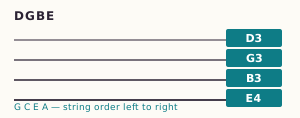
A different instrument wearing the same name
Baritone tuning is D3, G3, B3, E4 — the top four strings of a guitar, in the same order, at the same pitches. It is linear, not re-entrant, and the instrument that carries it is usually 19 to 21 inches long instead of 13 to 15.
That size difference matters more than the tuning. A baritone's longer scale means wider fret spacing, so the stretches that are easy on a soprano become real work; and higher string tension means you can hit it harder before it buzzes.
Transposing without learning anything new
If you play a GCEA chord shape on a baritone, you hear a chord a fourth lower. C (0003) becomes G, G (0232) becomes D, F (2010) becomes C. Three ways to handle it:
- Transpose the song. Play
Amazing Gracein D shapes and it sounds in G. - Learn baritone shapes. Baritone chord books exist and the shapes are the guitar's top four strings.
- Use a capo on fret 5. This returns the instrument to GCEA pitch, minus the re-entrant high G. Useful in an emergency, clumsy for regular playing.
When baritone is the right choice
- Singing in a low register. A baritone sits where a male voice naturally is, and the songs in this book transposed down a fourth stop straining.
- Playing with a guitar. The top four strings of a guitar and a baritone ukulele are the same pitches, so the two instruments agree without transposition.
- Playing alone in a small room where a soprano sounds thin.
When it is the wrong choice
Group playing, because the baritone cannot reach the high G sparkle that carries a strum-along; and any arrangement written specifically for the re-entrant sound, which will lose its top line.
Questions that come up
Can I still use the sheets on this site?
Yes, with one adjustment: everything sounds a fourth lower than written. If you want to sing the same melody in the written key, transpose up a fourth (add three sharps to the key signature) or capo at fret 5.
Is a baritone ukulele just a small guitar?
Functionally, it is the top four strings of a guitar with no low E or A. It is played with ukulele technique — four-finger chord frames, no bass runs on the low strings — but it occupies the guitar's register.