D · GCEA
Shenandoah
A river song about a trader who falls for a chief's daughter. Very slow, very wide, and the only song here where the first chord is not the tonic.
Tuning: GCEA · Capo: none · Tempo: 68 bpm · Metre: 4/4 · Level: intermediate


Words and music: Traditional American river song, collected from the 1840s onward and printed in sheet-music form by 1880s. Public domain.
The sheet
 D-DU-UDU
The A7 is the engine
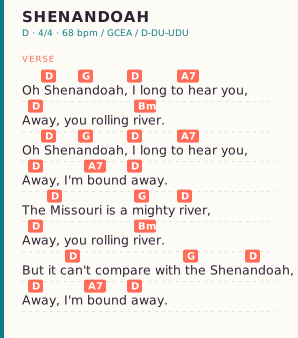
This verse never sits still: D, G, D, A7 — every bar moves. The A7 (0100, one finger) is what keeps it rolling, and the Bm on the third line is the one moment of shadow. Play the A7 short and let the D answer it.
- Bar 4 and bar 8 both land on A7, then resolve to D on the next downbeat.
- Hold the Bm for a full bar. It is the emotional centre of the verse.
- Do not add a D7 anywhere. This song is modal and a D7 will make it sound like a pop song.
Singing a river song
The melody is pentatonic — it can be sung entirely on the black notes of a piano — which is why it sounds ancient and why it is easy to harmonise in a group. Two guidelines:
- Long notes at the end of each line. Let them ring and breathe in the gap.
- The "away, you rolling river" refrain is quieter than the verse, not louder. It is an aside, half to yourself.
Tuning and capo
In D the melody sits between A and the D an octave above, which is comfortable for most male voices. Female singers usually move it up to F (capo 3 with D shapes) or G (capo 5). Anything higher and the low A in the verse disappears.
Questions that come up
Is it about the river or the woman?
Both readings are traditional. The most common story is a trader in love with the daughter of an Algonquin chief named Shenandoah; the other reads the word purely as the river in Virginia and West Virginia.
Why no D7 at the end of the verse?
Because a D7 would create a stronger pull back to the tonic than this modal melody wants. The A7 to D resolution is already enough, and adding a seventh makes the song sound modern.