Am · GCEA
Scarborough Fair
A modal ballad in A minor with a melody that never resolves where you expect. The herb refrain is the hook, and the chords under it barely move.
Tuning: GCEA · Capo: none · Tempo: 80 bpm · Metre: 3/4 · Level: intermediate


Words and music: Traditional English ballad, collected in the 19th century from oral sources. Public domain.
The sheet
 D-DU-DU
The chord that never lands
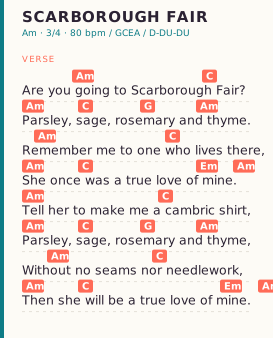
The whole melody circles E and never settles on A until the end of the verse. That is why the E minor chord in bar four sounds unfinished: the tune is deliberately refusing to close. If you add a G sharp to that Em and make it an E major, the song becomes ordinary — resist the urge.
- Verse: Am, C, Am, C, G, Am for the first two lines.
- Bar four alternates Em and Am depending on which collected version you are singing.
- Keep the last Am short. It is a comma, not a full stop.
The refrain is the rhythm section
"Parsley, sage, rosemary and thyme" is sung in strict time with one chord, and it functions as the song's groove. Do not slow down for it, and do not add a chord change inside it. The listener uses those four words to find the beat.
Modal singing
This ballad has no harmonic sevenths and no cadence in the modern sense, so it will sound odd to ears trained on pop music. Play it soft, let the open strings ring, and use the C chord as a colour rather than a destination. On a low G ukulele the modal character is even clearer because the bass line stays with the melody's root notes.
Questions that come up
Do I sing the herbs at the same volume as the verse?
Slightly softer, and dead in time. The refrain is a rhythmic anchor; if you push it harder than the verse lines the shape of the song flips.
Which collected version are the words from?
The verses printed here are the standard 19th-century set. Other collections have a different final verse and a slightly different third line; both are sung in folk clubs.