Am · GCEA
Wayfaring Stranger
A minor-key hymn with four chords and one long breath. The muted stroke in the pattern is what stops it sounding sentimental.
Tuning: GCEA · Capo: none · Tempo: 76 bpm · Metre: 4/4 · Level: intermediate


Words and music: Traditional American folk hymn, printed in shape-note collections from the 1830s. Public domain.
The sheet
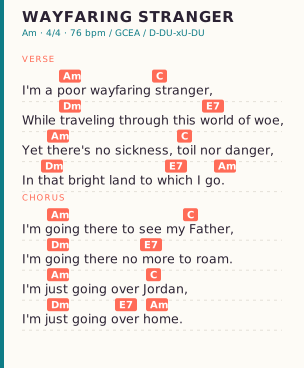
 D-DU-xU-DU
The muted stroke is doing the work
Use D-DU-xU-DU: the third stroke is a mute. Without it this hymn turns into a slow four-square strum and sounds like a campfire sing-along instead of a lament. The mute lands on the "and" of beat two, exactly where the melody has a gap.
The chord vocabulary of a minor hymn
Am, C, Dm and E7 — this is the minor-key companion to the C-F-G7 set, and it unlocks dozens of folk hymns. The movement that matters is Dm to E7 at the end of each line: the bass walks up D to E while the melody sits on C sharp, then falls to A. Play that pair slowly, twenty times, as an exercise.
- Am (2000) — one finger, open and wide.
- Dm (2210) — three fingers in a straight diagonal, index on the E string's first fret.
- E7 (1202) — pinky stretch; the hardest shape in the set.
Singing it without over-emoting
This is the most-recorded American folk hymn after Amazing Grace, and most of the bad versions share one fault: they get louder at the chorus. Do the opposite. Keep the verse at a conversational level and let the chorus stay soft, with a small lift only on "Jordan". The words are already dramatic; the melody does not need help.
Questions that come up
What is a shape-note collection?
A 19th-century American hymnal that printed notes as geometric shapes (triangles, squares, diamonds) so that singers could read intervals without formal training. Wayfaring Stranger circulated widely in those books.
Why is the pattern different from the island strum?
Because of the mute. D-DU-xU-DU replaces the third stroke with a percussive click, which keeps a slow minor hymn from turning into a steady strum.