C · GCEA
Oh! Susanna
A two-beat romp with a chorus that repeats the same four bars. Good for groups, because nobody has to remember a second verse.
Tuning: GCEA · Capo: none · Tempo: 112 bpm · Metre: 2/4 · Level: beginner


Words and music: Stephen Foster, 1848. Published by W. C. Peters & Co. Public domain in every territory.
The sheet
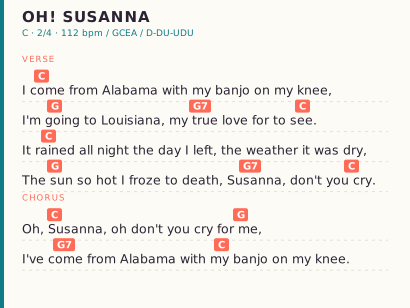
 D-DU-UDU
The count that makes it work
This sheet is written in 2/4, so every bar has two beats, not four. That is not a typo — the original 1848 publication is a two-beat song, and it is what gives the tune its bounce. Count 1-2, 1-2 and let the D-DU-UDU pattern stretch across two bars.
If four-beat counting feels more natural, double every chord: one bar of C becomes two bars of C. The singing is identical; only your mental arithmetic changes.
Chord shapes and a one-finger cheat
C, F, G and Am cover the whole song. The G chord here is 0232, but you can substitute a plain G7 (0212) if the three-finger stretch slows you down — in a group sing-along nobody hears the difference.
- Verse: C for two bars, G for one, C for one.
- Chorus: C for two bars, G then G7 for one bar each, back to C.
- Change chords on beat one, not on the syllable — the melody already carries the accent.
Getting the words to land
"Alabama" is one word with the accent on the third syllable, and it falls on the strongest downstroke in the line. Speak the line in rhythm before you add the ukulele. Words first, chords second, always.
Questions that come up
Is 2/4 the same as 4/4 played fast?
No. In 4/4 the strong beat is 1 and the secondary accent is 3; in 2/4 every bar has one strong beat. Played at 112 bpm with two-beat bars this song pushes forward; the same notes in 4/4 sound square and heavy.
Can I sing this without the banjo verse?
Yes. Plenty of sing-alongs start straight on the chorus. If you drop the verse, repeat the chorus twice and add one instrumental pass of C-G-G7-C so the song still has a shape.