C · GCEA
Oh My Darling, Clementine
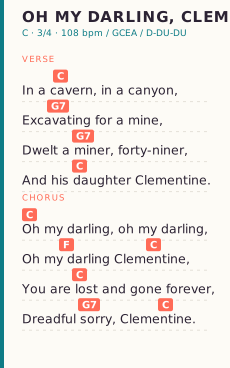
A waltz that moves fast enough to feel like a march. Three chords in the verse, one of them repeated for a whole line so you can relax.
Tuning: GCEA · Capo: none · Tempo: 108 bpm · Metre: 3/4 · Level: beginner


Words and music: Words and music: Percy Montrose, published 1884. Public domain.
The sheet
 D-DU-DU
Three chords, one repeated line
The verse stays on G7 for two full lines, which is unusual and very useful: it means you can play the whole second half of the verse with one hand shape and concentrate on the words. C and G7 are the only chords in the verse; F joins in the chorus.
G7 as 0212 uses three fingers. C7 as 0001 uses one. Do not confuse them — C7 is the one that sounds like it wants to go somewhere, and G7 is the one that goes home.
Waltz tempo without tripping
At 108 bpm in 3/4 this is fast for a waltz, and that is deliberate: the song is a comic lament, and its speed is the joke. Play it with a light touch and let the strum skim the strings.
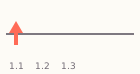
- Three strums per bar, D-DU-DU, no accents.
- The chorus should be slightly faster than the verse, not slower.
- "Clementine" always lands on beat one of the next bar. If you are early on that word, you are rushing the pattern.
The forty-niner detail
The "forty-niner" is a gold prospector who went to California in 1849. That single word dates the song precisely and gives you the setting: a mining camp, a canyon, a mine shaft. Knowing that makes the last verse land properly, and it is a good thing to say out loud before you play it to a room that has never heard it.
Questions that come up
Is it 3/4 or 6/8?
Printed sources use 3/4 for this song, which gives three even beats. SUNG versions often lean toward 6/8 because the words are dense. Pick one and stay with it.
Which is the "correct" last verse?
There is no canonical version. The most common final verse describes her lips above the water, blowing bubbles. Both that and the shorter three-verse form are traditional.