C · GCEA
Camptown Races
The fastest song in this book and the one that wears out beginners first. A two-chord verse, a brake, and a chorus that doubles in speed.
Tuning: GCEA · Capo: none · Tempo: 120 bpm · Metre: 2/4 · Level: beginner


Words and music: Stephen Foster, published 1850 by F. D. Benteen. Public domain.
The sheet
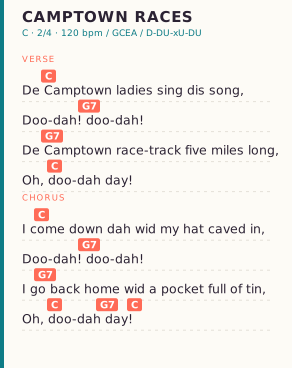
 D-DU-xU-DU
Two chords and a brake
The verse alternates C and G7 every two bars. The "Doo-dah! doo-dah!" line is the brake: it stops the harmonic motion entirely and hangs on G7 while the singers catch up. Play it quieter and shorter than the surrounding lines — it is punctuation, not a phrase.
The chorus adds F and C7 as passing colours but the skeleton stays C and G7.
Playing at 120 without tensing
Speed comes from the wrist, and a tense forearm is what actually limits tempo. Three things to check:
- Are you holding the neck in a death grip? The thumb should rest, not clamp.
- Is your right hand moving from the elbow? At this tempo the whole forearm should float from the elbow with the wrist relaxed.
- Are you strumming all four strings every stroke? Stop. At speed, three strings is plenty and sounds cleaner.
The strum pattern here is D-DU-xU-DU, the same one used on the Calypso page, because at 120 bpm the muted stroke is what keeps the rhythm from blurring.
Singing the dialect
The original 1850 text is written in an approximation of Black American English used by minstrel performers. That history is real and uncomfortable. Most modern sing-alongs either sing the dialect as printed or substitute neutral words ("the Camptown ladies sing this song"). Both are done. Say something about it if you are playing to an audience who will wonder — a one-line introduction is better than pretending the question is not there.
Questions that come up
Do I have to play it this fast?
No. Drop to 96 bpm and it turns into a pleasant mid-tempo song. The 120 figure here is the tempo that matches the recorded tradition.
What does "doo-dah" mean?
It is a nonsense syllable from the minstrel tradition, and it is the reason this song survives: the chorus is easy to join in cold, with no words to learn.