C · GCEA
Aloha Oe
Written in 1878 by a queen, and still the last song of the night at every Hawaiian gathering. Long phrases, slow tempo, and a chorus that wants you to breathe before you start it.
Tuning: GCEA · Capo: none · Tempo: 72 bpm · Metre: 4/4 · Level: intermediate


Words and music: Words and music: Queen Lili'uokalani of Hawaii, 1878. Public domain. Diacritics are simplified to plain apostrophes on this sheet.
The sheet
 D-DU-UDU
The chord that makes it Hawaiian
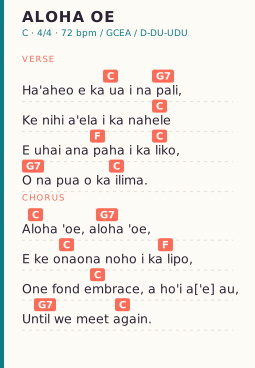
The whole sound of this song is the move from C to G7 and back. The F and Dm are decoration; the Hawaiian feeling lives in the C-G7 oscillation, which mimics the rise and fall of a falsetto line. Play it slowly and let the G7 ring: the F and D inside that chord are what the melody leans on.
- Bars 1-2: C, then G7 on "pali".
- Bars 3-4: the melody walks down; Dm here instead of F gives a darker verse ending.
- The chorus is the most-quoted four bars in Hawaiian music. Nothing to change.
Long phrases, one breath each
Each verse line is four bars long with no internal rest. If your voice runs out before the end, the phrase is not too long — you are starting it too loud. Begin at about 70 percent volume and let the last two notes fade rather than push.
Capo 1 or 2 sharpens the top line and is how most contemporary Hawaiian groups perform it; the shapes stay C, G7, F and Dm. If the room is singing along in a low register, stay at capo 0.
A note on the apostrophes
The Hawaiian ʻokina is a consonant, not punctuation, and it changes meaning. On this sheet it is printed as a plain apostrophe so that the file stays readable in every browser and every tuner app. If you are singing in public in Hawaii, learn the real marks; elsewhere, pronounce them lightly and nobody will flinch.
Questions that come up
Is it really written by a queen?
Yes. Lili'uokalani, then crown princess and later the last monarch of Hawaii, composed it in 1878. It was published in 1884 and passed into the public domain long ago.
Why does the sheet use Dm instead of F in the verse?
Both work. F is the more common printed choice; Dm (2210) shares three of its four notes with F and adds the sixth degree, which makes the verse end darker and sets up the brighter chorus better.