F · GCEA
Kangding Love Song
A Sichuan folk song built on repeated two-note figures. The "liu liu" syllables are the hook, and they map perfectly onto a down-up stroke.
Tuning: GCEA · Capo: none · Tempo: 88 bpm · Metre: 4/4 · Level: intermediate


Words and music: Traditional folk song from Kangding, Sichuan, collected and printed in the 1940s from local oral tradition. Public domain.
The sheet
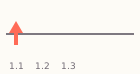 D-DU-UDU
Why "liu liu" sits under your right hand
The phrase "liu liu" (溜溜) is a filler syllable inserted before the last two syllables of each line. It falls on the second half of the bar, which is exactly where the upstroke lives. Sing "liu-liu" on the down-up and the rhythm looks after itself.
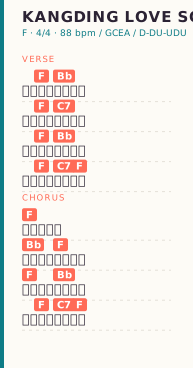
The chords repeat the same two-bar cell eight times: F, Bb, F, C7. Once you have the first line, you have the whole verse.
A Sichuan melody in F
Written in F because the melody sits between C and the F an octave above, which is comfortable for most voices. Bb is the barre chord; if it fights you, use Gm (0231) once per line as a substitute, or transpose the song to C and lose the barre entirely.
- Bars 1-2: F, Bb. Bars 3-4: F, C7.
- The chorus drops to a lower register — sing it softer, not louder.
- Dm appears only if you add the optional second verse harmonisation.
Where the song comes from
Kangding (康定) is a town in western Sichuan on the old tea route to Tibet, and the song is a courting song collected from local singers. The "pao ma shan" in the first line is the horse-racing hill above the town. It was printed nationally in the 1940s and has been a standard Chinese folk-song repertoire piece ever since.
Questions that come up
Are the "liu liu" syllables part of the words?
No. They are filler, and different printed versions place them differently. They exist to fill the second half of the bar and to keep the line's rhythm even.
What is the "yue liang wan wan" line?
It is the chorus's opening line — "the moon is curved" — and it functions as a pickup into the title phrase. Sing it on a single F chord and hold the last syllable slightly.