F · GCEA
Jasmine Flower (Mo Li Hua)
The best-known Chinese melody in the world, and a genuine workout in F: the only chord family on this site that makes you barre two strings at once.
Tuning: GCEA · Capo: none · Tempo: 84 bpm · Metre: 4/4 · Level: intermediate


Words and music: Traditional Chinese folk song, Jiangsu variant, documented from the 18th century and quoted by Puccini in Turandot (1926). Public domain. English words on this sheet are ours.
The sheet
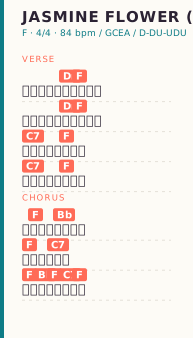
 D-DU-UDU
Two words about Bb
Bb (3211) is the hardest shape in the five key families on this site: you barre the top two strings at fret 1 with the index finger while the ring, middle and index cover G, C and E. If it buzzes, the problem is almost always the barre, not the fingers behind it. Roll the index finger slightly onto its side, press close to the fret wire, and pull your elbow in toward your ribs.
Until it rings cleanly, use Bb as 3211 → 3210 (leave the A string open). It is technically a Bb6, but in this song it sits under the melody and reads as a Bb.
The shape of the tune
Jasmine Flower is built on one phrase that repeats a step higher before it falls away. Bars 1-2 are the same melodic cell, bars 3-4 walk down the scale, and the chorus is a rising sequence that ends on the tonic. That structure is why the song survives translation into any language: it is nearly impossible to sing it in the wrong shape.
- The Dm in bar 1 is a passing colour, one beat only.
- C7 carries the phrase ends; hold it for the full bar and let the F land on beat one.
- The chorus should slow slightly on "茉莉花呀茉莉花" — that is the traditional reading, not a mistake.
Playing it for an English-speaking room
The whole point of this song is the flower. If you are singing to a room that does not know Mandarin, sing the English words on this sheet; if the room knows the Chinese, sing the Chinese. Do not mix them mid-verse — the syllable counts are different and the melody will force you to rush.
Questions that come up
Puccini quoted this melody — does that affect the copyright?
No. The folk melody itself predates any copyright, and Puccini's Turandot premiered in 1926; the quoted phrase is short and the opera's own term has no bearing on performing the folk song.
Can I avoid Bb entirely?
Partly. You can substitute Bb with Gm (0231) in the chorus for a darker colour, or transpose the whole song to C (shapes C, F, G7, Am) and lose the barre entirely. The melody sits fine in C on a soprano ukulele.