Am · GCEA
Greensleeves
Six beats per bar, and the oldest song in this book. The whole piece is one descending bass line; once you hear it you will never lose your place again.
Tuning: GCEA · Capo: none · Tempo: 92 bpm · Metre: 6/8 · Level: intermediate


Words and music: English broadside ballad, registered by Richard Jones in 1580. Public domain.
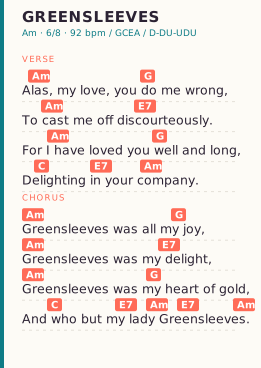
The sheet
 D-DU-UDU
The descending line
Play the lowest note of each chord and you will hear it: A, G, A, E — then A, G, C, E, A. That is the "passamezzo antico" bass line, a Renaissance pattern older than the song itself. Everything else in the arrangement is decoration over it. If you ever get lost, find the bass note and you are back.
Counting six
The song is in 6/8, not 3/4, and the difference is not academic. 6/8 has two beats per bar (each divided into three), while 3/4 has three. Play the island strum as written and the bar will feel long; count "1-2-3, 2-2-3" with a slight lean on 1 and 2.
- Group the strums: three down-ups inside each of the two beats.
- The E7 in bar four should be held, not clipped. It is the strongest note in the phrase.
- The chorus turns on the E7 at the end of "Greensleeves was my delight" — that is where the harmonic tension sits.
Playing it well on four strings
Every chord here is in first position with no barre. Am (2000) is one finger; G (0232) is three; E7 (1202) needs the pinky stretch. The only thing that makes Greensleeves sound hard is the tempo: played fast it turns into a jig and loses all its melancholy. Keep it between 88 and 96 bpm.
Questions that come up
Is this really a 16th-century tune?
The words were registered in 1580 and the tune appears in sources from the 1580s onward. Shakespeare mentions it twice. It is comfortably public domain everywhere.
6/8 or 3/4 — does it matter if I am only strumming?
It matters more when strumming than when picking. In 6/8 the pattern has a long-short lilt; the same strums read as 3/4 give three even beats and the song loses its swing.