G · GCEA
Deck the Halls
A Welsh New Year tune with English Christmas words bolted on in 1862. Four chords, a nonsense refrain, and a tempo that punishes hesitation more than wrong notes.
Tuning: GCEA · Capo: none · Tempo: 116 bpm · Metre: 4/4 · Level: beginner


Words and music: Tune: Welsh melody "Nos Galan", printed 1784. English words: Thomas Oliphant, 1862. Public domain.
The sheet
 D-DU-xU-DU
The shape of the "fa la la" bars
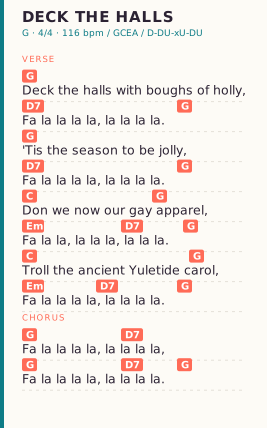
The refrain bars are two chords each: G on the strong beat, D7 on the second half of the bar. Play them as a light down-up, down-up and do not accent the D7 — it is a passing chord, not a destination. Beginners hammer it, and the song turns into a stomp.
- Verse line 1 and 2: G, then D7, then G.
- Line 3 adds C and Em. Em is optional: substitute G and the song still works.
- Line 4 mirrors line 3 and ends on G.
Fast, but in control
At 116 bpm the muted stroke pattern D-DU-xU-DU keeps the rhythm crisp. If it blurs, you are playing too loudly: reduce volume and increase precision. Speed is not the problem, tension is.
Where the tune comes from
"Nos Galan" is a Welsh New Year's carol printed in 1784, with words about giving gifts, drinking and, in some verses, a man asking for a kiss. The English Christmas words are Thomas Oliphant's from 1862. The tune was also used for the New Year's Eve custom of going door to door singing before midnight. Only one verse of the English text is widely known today; the others are long, comic, and rarely printed.
Questions that come up
Is Em required in the third line?
No. It adds a minor colour that makes the line interesting, but substituting G keeps the harmony plain and singable. If you keep the Em, hold it for a full bar.
Why does my version sound different from the recording I know?
Recordings often transpose to C or add a modulation for the last chorus. The tune itself is fixed; the arrangement choices are not.