D · GCEA
Auld Lang Syne
The song everyone sings wrong because nobody knows the second line. Here is the whole thing in D, with the two bars where the room always drifts.
Tuning: GCEA · Capo: none · Tempo: 76 bpm · Metre: 4/4 · Level: intermediate


Words and music: Words: Robert Burns, 1788, drawing on earlier Scottish fragments. Traditional melody. Public domain.
The sheet
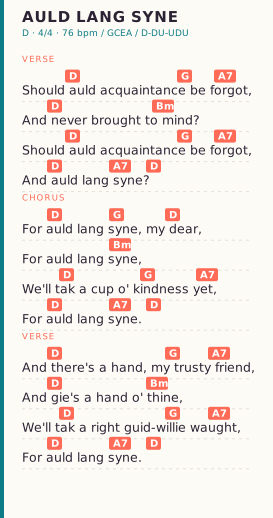
 D-DU-UDU
The two bars that catch everyone
Bar four of each verse moves D → A7 → D inside four beats, with the melody sitting on the high D. Amateurs either rush it or drop the second chord. Play it 20 bpm slower than you think you need, and put a small gap before the final D so the singing has somewhere to land.
In the chorus, "syne, my dear" is where the key change in feeling happens: the Bm in bar two of the chorus is the only minor chord in the song and it is what makes the last line ache.
Bm without tears
Bm as 4222 is a barre across the top three strings at fret 2 with the pinky on the G string at fret 4. If a full barre is a month away, use a Bm7 at 2222 — same function, no stretch, and in a noisy room nobody can tell.
- Alternative 1: play 4322 and mute the G string with your thumb.
- Alternative 2: substitute D for Bm. Loses a little colour, keeps the song singable.
Why D and not C
The tune's highest note is the D an octave above the open D string. In D that lands on the open top string, which rings forever on a ukulele. Transposed to C it lands on fret 2 of the A string and every phrase sounds pinched. Play it in D, capo 0.
Questions that come up
Is A7 really just one finger?
Yes: 0100 is the index finger on the second fret of the C string with everything else open. It is the single easiest chord on the instrument and it does real harmonic work here as the dominant of D.
Should I sing the Scots spelling or the English one?
Sing it as spelled in the sheet. The Scots forms (tak, gie's, guid-willie) are one syllable where the English equivalent is two, so they actually fit the melody better.