G · GCEA
Amazing Grace
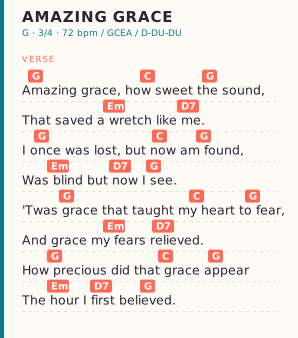
Three beats to the bar, four chords, and a melody that breathes. The first waltz most ukulele players learn, and the one that sounds best with no accompaniment at all.
Tuning: GCEA · Capo: none · Tempo: 72 bpm · Metre: 3/4 · Level: beginner


Words and music: Words: John Newton, 1779. Tune "New Britain", first printed 1835 in Southern Harmony. Public domain.
The sheet
 D-DU-DU
Counting three, not four
The single biggest mistake on this song is counting it in four. It is a waltz: 1-2-3, 1-2-3. The chord change lands on beat one, and the second half of the bar is where the melody hangs. If you count four you will rush the third beat and the whole thing starts to trot.
Play the D-DU-DU pattern as: down on 1, down-up on 2, down-up on 3. That is six strums across two bars, and it gives the tune its lift.
The Em shape is optional
Em (0432) is the one shape here that beginners grimace at. Two ways around it:
- Replace Em with G. The progression becomes G-C-G-D7, which is still recognisably the same hymn.
- Replace Em with C. Slightly more movement in the bass, still consonant. Dorothy's favourite trick in church groups.
D7 as 2223 uses all four fingers in a neat diagonal; if that is too much, play D7 as 2020 (G and C strings at fret 2) — a thinner D7 that works fine for a solo singer.
Capo and key
The tune sits between D and the D an octave up, which is comfortable in G. If your group sings low, move the capo to fret 2 (shapes unchanged, sounding in A). Do not transpose down to C unless you also move the melody — in C the top line gets muddy on a soprano ukulele.
Questions that come up
Why is the D7 shape written as 2223 and not 2020?
Both are D7. 2223 is the full four-note version with the F sharp on the A string (fret 3) — it is the shape that carries when you are strumming hard in a group. 2020 is the three-note shell, cleaner for a solo voice and easier for small hands.
Can I play this in 4/4?
You can, and many buskers do, but you lose the waltz feel entirely. If you must, keep the three-beat phrase by playing the third beat as a rest instead of a strum.